Top 7 Free AI Voice Cloning Software Accessible to All in 2026
In 2026, your voice is no longer just a way to speak — it is a digital asset. AI voice cloning has evolved from a novelty feature into a practical tool for us. Users are no longer asking whether AI voice cloning works, but instead which AI voice cloning software is best. Cost limitations, character caps, ethical concerns, and commercial usage rights are now key decision factors.
This guide provides a practical, experience-based analysis of the 7 AI voice cloning tools with usable free tiers, explaining how the technology works, how the tools differ, and how to choose the right solution for your specific needs.
How We Test
All AI voice cloners were evaluated through hands-on testing using identical input samples, focusing specifically on voice cloning performance rather than generic text-to-speech quality. We analysed how much training audio was required, how accurately each system preserved vocal identity, emotional inflexion, pacing, and pronunciation, and how usable the free tier was in real-world scenarios. Additional factors included export quality, latency, commercial-use permissions, and whether advanced controls, such as SSML or real-time adjustment, were supported.
Part 1: What Is AI Voice Cloning?
AI voice cloning uses deep learning models to recreate a specific human voice, allowing new text to be spoken in that same vocal identity. Unlike traditional text-to-speech, which outputs generic voices, modern voice cloning focuses on preserving tone, cadence, and personality. In 2026, high-quality cloning can be achieved with only a few minutes of clean audio, making it accessible to individual creators and teams alike.
How AI Voice Cloning Works Today
The process begins by analysing recorded speech to identify vocal patterns, such as pronunciation, rhythm, and pitch variation. Neural networks then learn how these elements interact across different contexts. During synthesis, written text is converted into speech that follows these learned behaviors, producing output that sounds consistent and natural rather than mechanically generated.
The Role of SSML in Natural Speech
SSML plays a key role in bridging the gap between acceptable and human-like output. By controlling pauses, emphasis, and pacing, users can reduce monotony and unnatural sentence endings. This is especially important for long-form narration or emotionally nuanced content, where timing and stress patterns define realism.
Part 2: Top 7 AI Voice Cloning Software
Below are the most reliable voice cloning apps that offer meaningful free access, each excelling in a different use case.
1. Fish Audio – The Expressive Newcomer
Best For: Emotional narration, short-form content, character voices
Price: Free tier available with usage limits; paid plans unlock extended generation
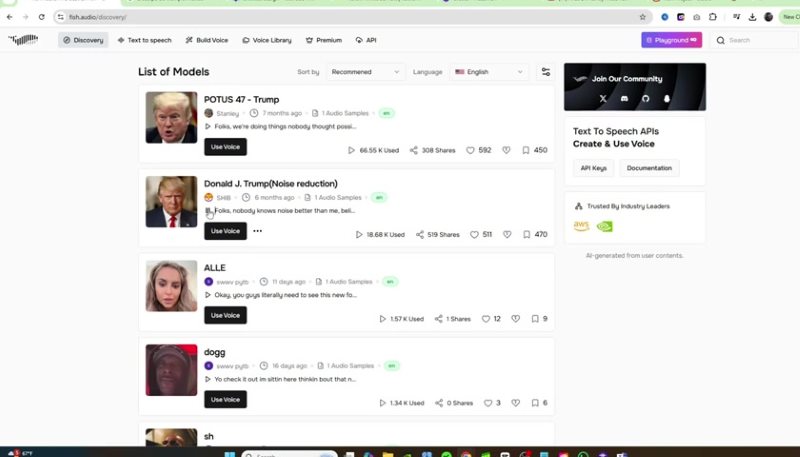
Fish Audio has quickly emerged as one of the most expressive AI voice cloning tools available. Its core strength lies in emotional delivery — the cloned voices capture subtle variations in tone, energy, and conversational dynamics better than many established competitors. This makes it particularly effective for storytelling, social media videos, and dialogue-heavy scripts.
The platform requires relatively little training data and delivers fast synthesis, allowing users to iterate quickly. While its voice management and export controls are less advanced than those of enterprise-focused tools, it excels at making AI-generated voices sound natural, lively, and engaging — a critical factor for creators who prioritize realism over scale.
Pros
- High emotional range.
- Fast voice generation.
- Minimal setup required.
Cons
- Limited commercial rights on the free tier.
- Fewer advanced configuration options.
2. TTSMaker – The Unlimited Workhorse
Best For: Long scripts, bulk generation, multilingual projects
Price: Free tier with generous character limits
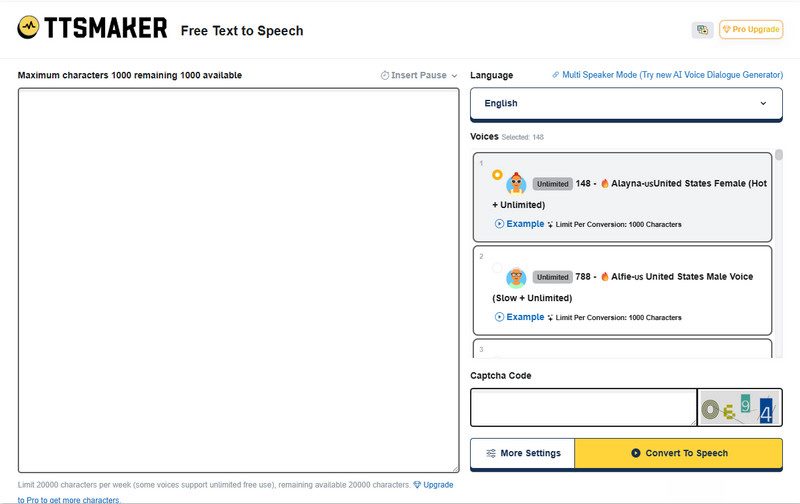
TTSMaker stands out for one reason: scale. Unlike many tools that heavily restrict free use, it offers unusually high character allowances, making it ideal for long-form narration, e-learning materials, or large-batch projects. Its voice cloning quality varies by language but remains reliable for clear, neutral speech.
While emotional nuance is not its strongest feature, this tool compensates with consistency and accessibility. You can change your voice with AI without worrying about strict limits or complex workflows. It remains one of the most efficient free solutions available.
Pros
- Very high free usage limits.
- Simple web-based interface.
- Broad language support.
Cons
- Limited expressiveness.
- Less control over vocal identity fine-tuning.
3. Speechify – The Productivity Giant
Best For: Reading, learning, accessibility, productivity
Price: Free tier available; premium at $29/month
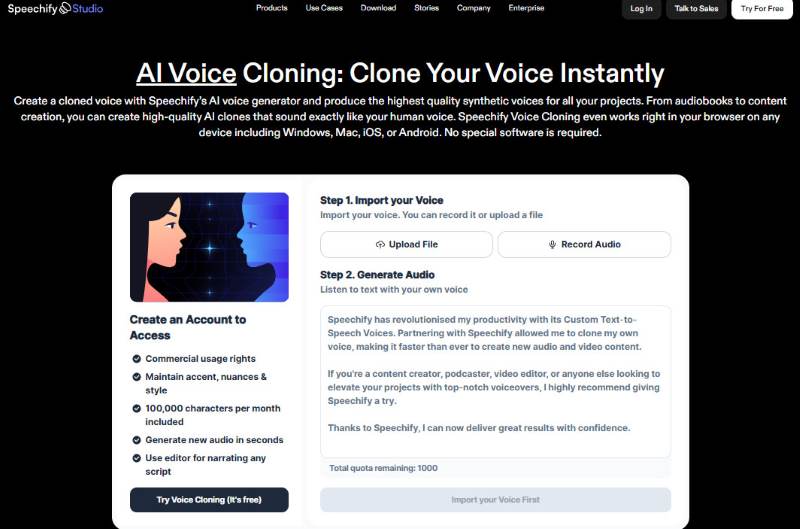
Speechify focuses less on creative voice manipulation and more on clarity, stability, and user experience. This AI voice trainer is optimized for reading-based scenarios, such as converting documents, articles, and study materials into natural-sounding audio.
Although customization options are limited compared to creative tools, Speechify delivers consistently clean output across devices. Its strength lies in making information accessible and easy to consume rather than producing dramatic or emotionally complex speech.
Pros
- Stable, clear voice output.
- Excellent cross-platform support.
- Strong text handling accuracy.
Cons
- Limited emotional control.
- Less suited for character-based content.
4. Kits.ai – The Musician’s Choice
Best For: Singing voice cloning, vocal demos, music production
Price: Free tier with restricted exports
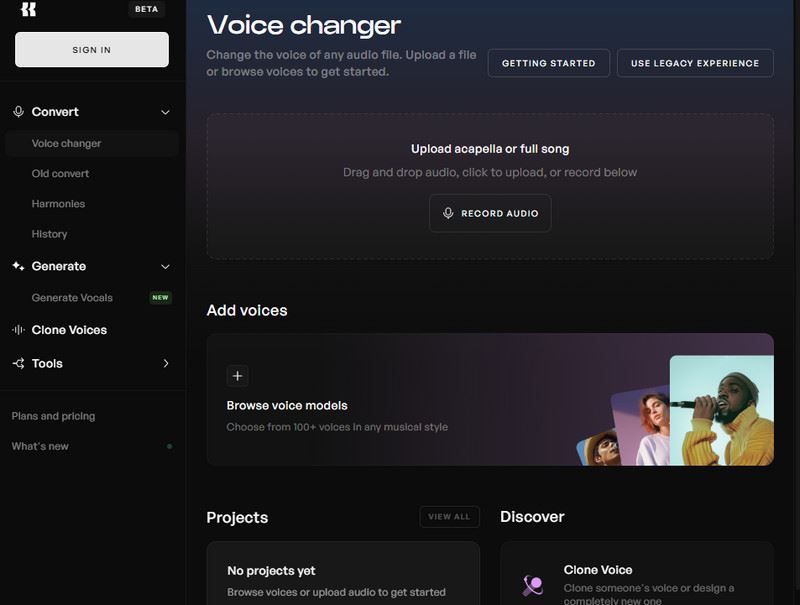
Kits.ai is purpose-built for music creators rather than traditional narration. Unlike most voice cloning apps, it supports singing voice transformation, making it a popular choice for producers creating vocal demos or experimenting with different vocal styles.
The platform offers a creative workflow tailored to music, but it is less suitable for long spoken narration. If you want to make your own AI voice with vocal tone, pitch control, and musical expression, Kits.ai fills a niche that standard TTS tools do not address.
Pros
- Singing voice support.
- Strong creative tools for musicians.
- Unique vocal styles.
Cons
- Not optimised for spoken content.
- Steeper learning curve.
5. Descript – The Podcaster’s Editor
Best For: Podcasting, video editing, voice correction
Price: Free tier includes limited Overdub usage
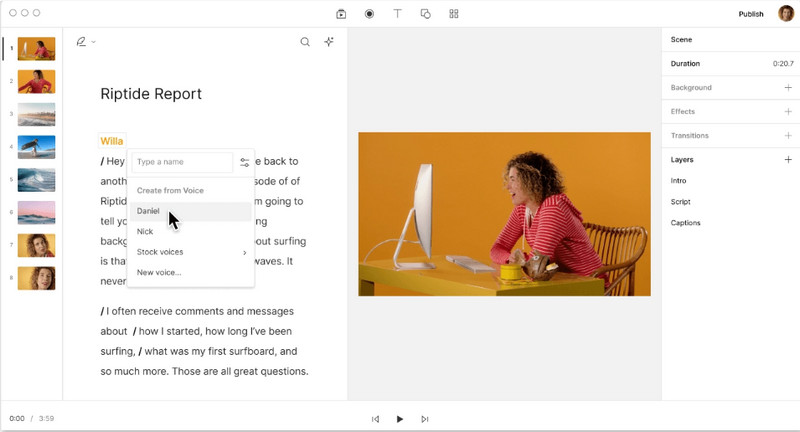
Descript integrates voice cloning directly into an audio and video editor, allowing creators to regenerate missing words or fix mistakes without re-recording. Overdub is not designed for high-volume voice generation but excels in editorial precision and natural conversational flow. This makes it ideal for podcasters and video editors who value accuracy and seamless integration over experimental voice creativity.
Pros
- Tight editing integration.
- Natural conversational tone.
- Strong transcription alignment.
Cons
- Limited free usage.
- Not designed for bulk generation.
6. HeyGen – The Visual & Audio Hybrid
Best For: AI avatar videos, explainers, corporate presentations
Price: Free plan with watermark and limits
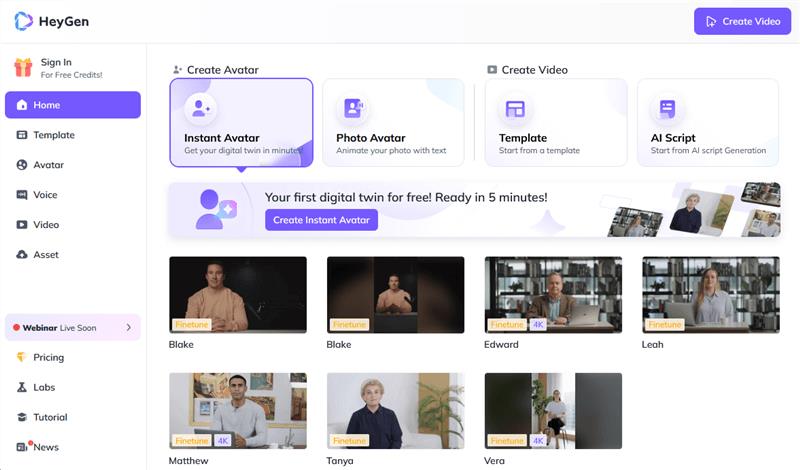
HeyGen combines voice cloning with AI-generated avatars, allowing users to produce talking-head videos without cameras or studios. The voice cloning component is optimized to synchronize naturally with lip movements and facial expressions, making it a powerful voice clone freeware for visual storytelling. While less flexible as a standalone voice engine, HeyGen excels when voice is part of a broader video production workflow.
Pros
- Integrated voice + avatar system.
- Professional visual output.
- Fast video generation.
Cons
- Branding restrictions on the free tier.
- Less control over voice-only output.
7. Resemble AI – The Security & API Leader
Best For: Developers, enterprises, real-time applications
Price: Free trial, usage-based pricing
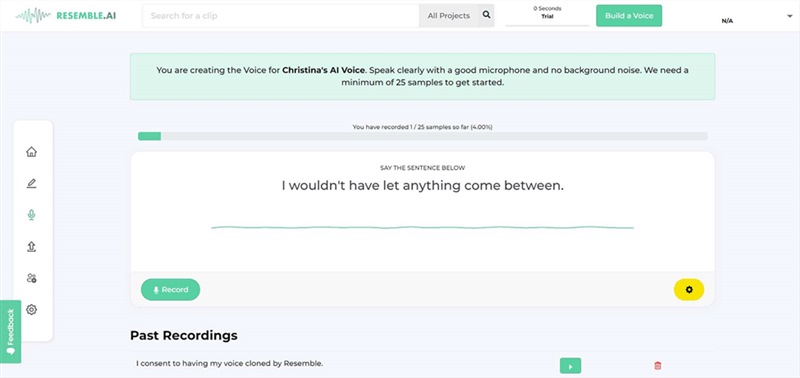
Resemble AI is a voice cloning tool with a free trial designed for professional and enterprise use cases where security, consent, and real-time performance matter. Its APIs support live voice synthesis and enforce consent-based model creation, making it a trusted option for commercial deployments. Although not beginner-friendly, Resemble AI offers unmatched control and compliance for teams integrating voice cloning into products or services.
Pros
- Real-time voice synthesis.
- Strong consent and security framework.
- Advanced API access.
Cons
- Technical setup required.
- Limited appeal for casual users.
Part 3: Comparison of 7 AI Voice Cloning Software
| Premium Plan | Free Character Limit | Training Audio Required | Best For | Emotional Control | SSML Support | Commercial Rights |
| Fish Audio | $5.5/month (billed yearly) | Medium | Low (≈1–3 min) | Expressive narration, storytelling | High | Partial | Limited |
| TTSMaker | Beginners: $9.99/month
Creators: $18.99/month
Professionals: $24.99/month
Studios: $108/month | Very High | None or minimal | Long scripts, bulk TTS | Low–Medium | ❌ | ✔ |
| Speechify | $29/month | Medium | None | Reading, productivity | Medium | ❌ | Limited |
| Kits.ai | Starter: $10/month
Producer: $30/month
Professional: $60/month | Medium | Medium (≈5–10 min) | Singing voices, music demos | High | ❌ | Limited |
| Descript | Hobbyist: $16/month
Creator: $24/month
Business: $50/month
Enterprise: Custom | Low-Medium | Medium (≈10 min) | Podcast editing, voice fixes | Medium | ❌ | ✔ |
| HeyGen | Creator: $29/month
Team: $39/seat/month | Low | Low | AI avatar videos | Medium | ❌ | Limited |
| Resemble AI | Creator: $19/month
Professional: $99/month
Business: $699/month | Trial-based | Medium | Enterprise, real-time apps | High | ✔ | ✔ |
Part 4: Pro Tips for High-Fidelity Voice Cloning
Quality Beats Quantity in Training Audio
Short, clean recordings consistently outperform long but noisy ones. A few minutes of well-recorded audio with stable volume and minimal background noise give the AI voice trainer clearer signals to learn from. Poor input quality, on the other hand, directly limits the realism of the final output.
Use SSML to Fix Robotic Delivery
SSML should be treated as a practical correction tool rather than an advanced feature. Adding deliberate pauses and emphasis can smooth pacing, improve clarity, and make speech sound more intentional. These adjustments are particularly effective at fixing rushed phrases or flat emotional delivery.
Small Text Tweaks Improve Rhythm
Simple formatting choices, such as adding spaces after punctuation and breaking long text into shorter sentences, help models better interpret breathing and rhythm. These small tweaks often result in noticeably more natural speech without changing the voice model itself.
Part 5: Ethics & Security in AI Voice Cloning
Vocal Consent Is No Longer Optional
As AI voice cloning tools become widespread, ethical use has become a core requirement. Responsible platforms now require proof of consent before allowing voice model creation, treating vocal identity as a protected digital asset rather than disposable data.
The Rise of Voice-Based Fraud
Voice cloning has also enabled new forms of social engineering, particularly voice phishing scams. Because cloned voices can convincingly imitate trusted individuals, voice alone should never be used for identity verification. Users should remain cautious of urgent requests delivered through audio channels.
Why Platform Safeguards Matter
Not all AI voice cloners offer the same level of protection. Platforms that implement consent verification, traceable models, or watermarking provide stronger safeguards against misuse. For commercial and professional use, these protections are just as important as voice quality.
FAQs About AI Voice Cloning
Q: Is AI voice cloning legal?
A: Voice cloning is legal when used with proper consent. Ethical platforms require users to verify ownership of the voice or obtain explicit permission from the speaker. Making your own AI voice without consent, especially for impersonation or fraud, may violate privacy, identity, or consumer protection laws, depending on jurisdiction.
Q: Can I make AI-cloned voices sound more natural?
A: To improve realism, you can use clean training audio, avoid background noise, and apply SSML controls such as pauses and emphasis where supported. Simple text formatting adjustments, like adding spaces after punctuation, can also help improve pacing and breathing rhythm.
Conclusion
AI voice cloning in 2026 is not about replacing human presence but extending it. The best AI voice cloner depends on whether you value emotional expression, scale, creative experimentation, editing precision, visual integration, or enterprise-grade security. Testing two different platforms is often the most effective way to discover which system best captures your vocal identity — not just in sound, but in character.
Ethan Carter
Ethan Carter creates in-depth content, timely news, and practical guides on AI audio, helping readers understand AI audio tools, making them accessible to non-experts. He specializes in reviewing top AI tools, explaining the ethics of AI music, and covering regulations. He uses data-driven insights and analysis, making his work trusted.


 by
by