Explore TTS Meaning, Definition, Usage, and the Way it Works
The technology has evolved to the point that it has made the once impossible happen. Nowadays, you can easily have an audio narration for your video even without recording a voice-over. That became possible due to the feature we call Text-to-Speech, or TTS. That is why, if you are one of the people who are interested in knowing more about TTS, then let us discover the meaning of TTS and its usage in this article. Everything you need to know about TTS will be mentioned, so better to read it now
1. What is TTS
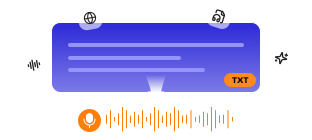
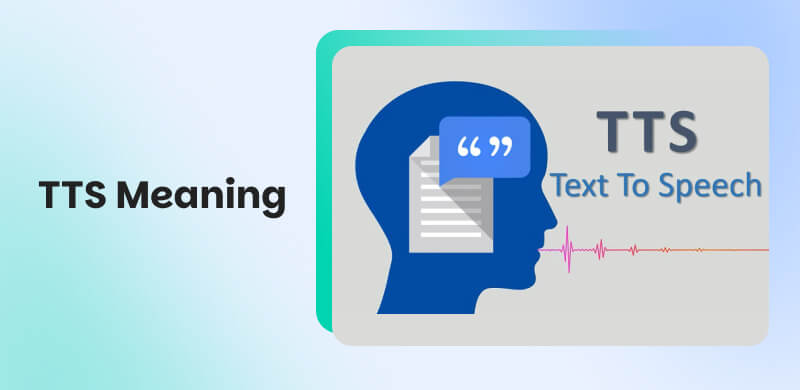
To define Text-to-speech technology, we only need to know that it is a software that takes text as input and converts it to an audible speech as output. In simple words, it goes from text to speech. In addition, a TTS system includes the software that predicts the best possible pronunciation of any given text. It also bundles in the program that produces voice sound waves; that’s called a vocoder. Moreover, a software that forecasts the optimal pronunciation of any given text is also included in a TTS system. Additionally, it has a program known as a vocoder that generates voice sound waves.
2. How Does Text-to-Speech Work
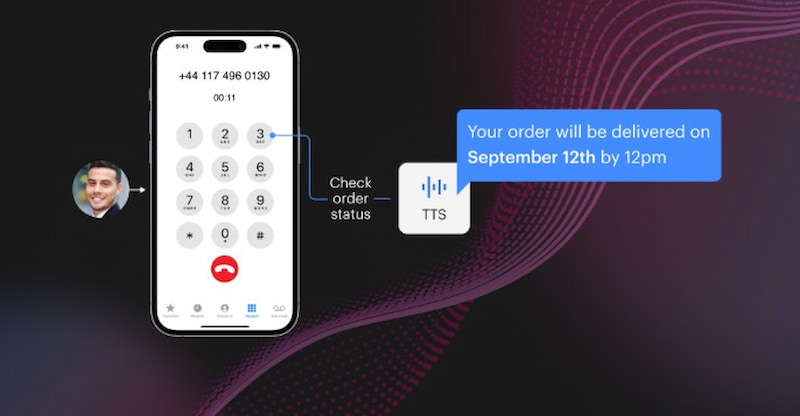
Text-to-Speech or TTS uses text processing, linguistic analysis, and voice synthesis to analyze text, transform it into phonetic sounds or known phonemes, and then use an acoustic model (typically deep learning-based) to synthesize these sounds into a natural-sounding audio waveform, controlling pitch, rhythm, and emotion before outputting the spoken words.
3. Benefits of Text-to-Speech
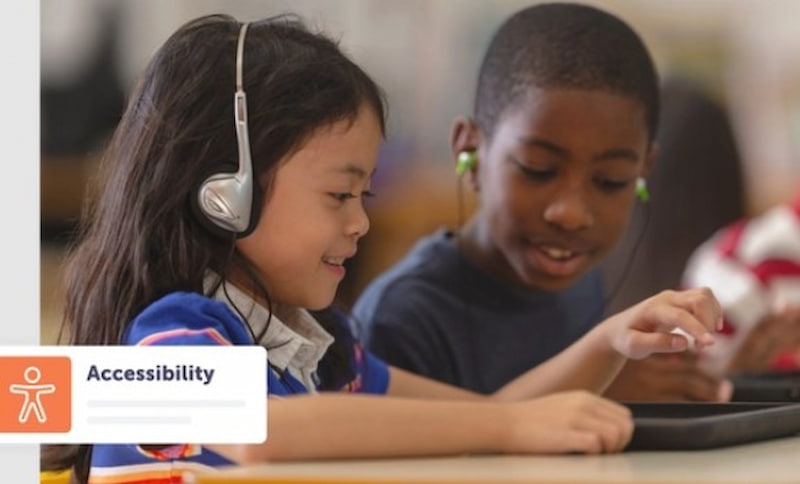
Text-to-Speech or TTS has significant advantages in terms of accessibility, supporting users with dyslexia or visual impairments, and learning, enhancing language and comprehension abilities through dual sensory input. On the business aspect, TTS improves customer experience with multilingual, individualized interactions, lowers agent fatigue, increases efficiency, offers round-the-clock help, and produces interesting content while saving money for organizations. It makes it possible to multitask, consume content while on the go, and help all users with editing and proofreading. Therefore, here are some key points in terms of the benefits of TTS.
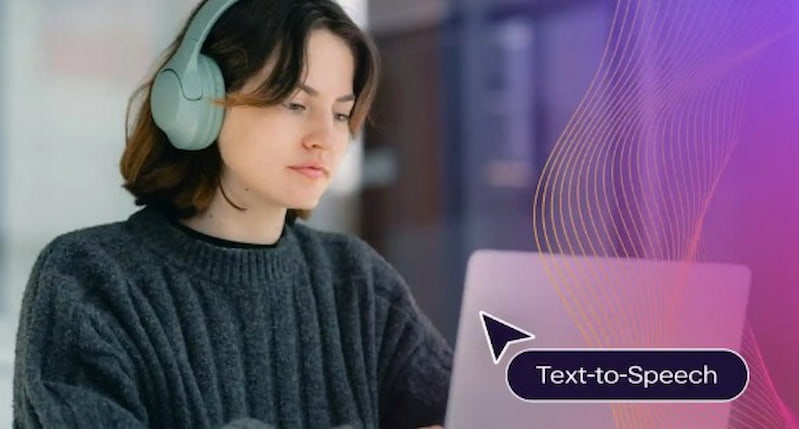
- • Enhances Reading and Comprehension. Reduces the strain of word decoding, enabling attention to be focused on meaning, which helps with dyslexia, low literacy, and focus.
- • Aids Learning Disabilities. Helps with editing and proofreading, supports auditory learners, and helps with pronunciation.
- • Improves Language Learning. Gives those with visual impairments access to digital content.
- • Boosts Engagement. Capturing audience attention.
- • Supports Productivity. Automates tasks like reading reports or data, freeing up time.
4. Limits of Text-to-Speech
Despite having amazing features, Text-to-Speech still has its own limitations. In line with that, here are the points that are based on users’ feedback and experience in terms of using TTS for different reasons:
- • Lack of Nuance and Emotion: Even highly skilled TTS frequently sounds robotic because of its inability to convey human-like intonation, emphasis, and emotion.
- • Contextual Misinterpretation: Having trouble understanding complex acronyms or homographs in the absence of clear contextual cues.
- • Technical/Processing Limits: Large projects are impacted by platform restrictions on text length, transactions per second, or file size.
5. Who Uses Text-to-Speech & Use Cases
The applications and users of TTS have evolved along with technology. TTS might not be necessary, but you will undoubtedly want it. Regardless of how you define yourself, text-to-speech can simplify your life and increase your productivity. Thus, when it comes to the question of who uses Text-to-speech, here are the common users of it. You might be one of them unconsciously. Without further ado, here they are below:
Content Creators
It is now a trend, especially with TikTok, the way of creating informative videos with an AI voice over on it. Therefore, if you are a content creator starter, then using TTS is a good tool that can help you start your content creation journey.

Students
Even if you identify as a kinesthetic student or a visual learner, experts say that adding an auditory element to your study routine may help you retain information and help you understand it with ease. And if nothing else, TTS makes proofreading a lot more manageable. For that, students are pretty much using it whenever they need to watch a visual presentation for their lessons.
Multitaskers
There are countless shortcuts that TTS can offer, such as transcribing instruction manuals when constructing furniture or reading recipes while cooking. Your own creativity is the only restriction on how much it can assist. Because of that, multitaskers in no specific field tend to use this.

6. Future of Text-to-Speech
In accordance with science and exports, the future of text-to-speech or TTS will center on more natural, adaptable, and integrated voice systems.
Advanced Human-tone Like Approach
Advances in deep learning will produce human-like voices with improved tone, emotion, pacing, and prosody, reducing robotic sound through transformer and diffusion-based models. These are the common limitations as we all know. That means, experts are continuously doing something to make it better.
Deeper Customization and Accessibility
In addition, customization and accessibility will expand as open-source tools enable domain-specific voices, better multilingual support, and inclusion of low-resource languages via transfer learning. On-device TTS will grow, offering faster and more privacy-friendly speech generation without cloud reliance.
Ethically Adaptability
At the same time, ethical and technical challenges will shape adoption. Safeguards against voice cloning abuse and misinformation, lower computational costs, and hybrid synthesis methods will be critical. Overall, TTS will become more ethical, efficient, and versatile across industries.
FAQs about TTS Meaning
Is voice recording the same as text-to-speech?
No. While voice recording necessitates a human speaker and recording equipment, TTS uses software to autonomously synthesize speech.
Does Text-to-Speech provide multilingual support?
Indeed. Many languages and dialects are supported by contemporary TTS systems, which use deep learning and artificial intelligence to increase accuracy.
Is it free to utilize Text-to-Speech?
While more sophisticated capabilities like genuine voices and personalization frequently call for premium plans, some TTS tools are free with restrictions.
Does text-to-speech fall under AI?
Indeed. Artificial intelligence and deep learning are used in modern TTS to produce voices that sound natural and resemble human speech patterns.
Is it possible for text-to-speech to mimic a human voice?
Although genuine pauses and delicate emotions are still being worked on, advanced TTS systems can sound remarkably similar to human voices.
Conclusion
Text-to-Speech (or TTS)has become an essential technology that transforms written content into accessible, engaging, and efficient audio experiences. From supporting accessibility and learning to enhancing productivity and content creation, TTS continues to evolve with more natural voices, deeper customization, and ethical safeguards. As AI-driven speech synthesis advances, TTS will play an even greater role across industries, making information easier to consume, more inclusive, and adaptable to the diverse needs of users worldwide.
Ethan Carter
Ethan Carter creates in-depth content, timely news, and practical guides on AI audio, helping readers understand AI audio tools, making them accessible to non-experts. He specializes in reviewing top AI tools, explaining the ethics of AI music, and covering regulations. He uses data-driven insights and analysis, making his work trusted.


 by
by