AI Dubbing Explained: Is It Safe and How It Works?
AI has permeated almost every aspect of the production of digital material, and one of the most fascinating advancements is AI dubbing. AI voice generation and dubbing have emerged as useful tools for creating professional-caliber voiceovers, regardless of your role as a content creator, marketer, educator, or corporate communicator. But many people are wondering what AI dubbing is, given the growing practice. How is it operated? Is it safe to name AI? To help you better grasp AI dubbing technologies, their advantages, safety problems, and future possibilities, this study examines these issues and more.
1. What is Dubbing AI?
Artificial intelligence dubbing, or AI dubbing, is the process of turning text, scripts, or recorded sounds into natural-sounding speech in a variety of languages and accents using machine learning and speech synthesis technology. It makes it possible to automatically create voiceovers for movies, cartoons, advertisements, e-learning materials, social media posts, and more. AI dubbing provides quicker, more economical, and scalable solutions than traditional dubbing, which calls for human voice actors, recording studios, and expensive post-production.
So, to put it simply, what does AI dubbing mean? It is the process of using artificial intelligence to produce or mimic human voices while preserving natural tone, intelligibility, and emotion based on text or audio samples.
2. How Does AI Dubbing Work?
The way videos are spoken in many languages and styles is changing thanks to AI dubbing. It captures emotions, simulates authentic human voice, and syncs flawlessly with video content thanks to artificial intelligence. While maintaining the message's clarity, interest, and professionalism, it helps producers save time, cut expenses, and reach larger audiences.
Machine Learning-Based Speech Production
Deep learning models that have been trained on extensive human speech datasets are the foundation of AI dubbing. To produce speech that sounds organic and human, these models examine tone, pronunciation, rhythm, and emotional expression. The AI automatically creates lifelike voices by learning how people actually speak.
Voice and Text Interpretation
AI uses natural language processing to process provided text or voice. Language, context, pauses, emphasis, and occasionally even emotion are all detected. This analysis results in speech that conveys the intended meaning, style, and tone, whether it is professional, conversational, or educational.
Automatic Synchronization and Adaptation
AI dubbing may modify voice attributes like gender, accent, pitch, and speed to fit various kinds of content. Additionally, it can synchronize the produced speech with the timing of the video, which makes it appropriate for voiceovers, instructional videos, movies, and presentations. Production is accelerated and human editing is decreased because of this automated alignment.
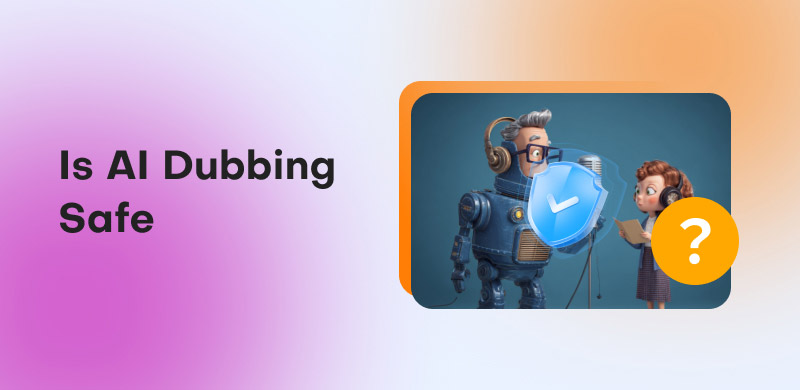
3. Is AI Dubbing Safe?
Is dubbing AI safe? is one of the most frequently asked questions. More precisely, is using an AI voice changer for dubbing safe? How responsibly it is utilized and if it complies with legal and ethical requirements will determine the response.
Possible Dangers:
- • Unauthorized use of someone’s voice for fraud or impersonation is known as voice cloning misuse.
- • Data privacy concerns include the possibility of collecting and storing voice recordings or personal information.
- • Deepfake Voice Risks: AI-generated voices have the potential to be manipulative or deceptive.
AI dubbing, however, can be secure if the right safeguards are in place. Avoiding uploading private voice recordings, never using someone else's voice without their consent, and using AI dubbing systems that safeguard user information, guarantee privacy, and explicitly disclose how they handle voice inputs are all crucial.
So, is it safe to dub AI? If users adhere to safe procedures and the system they use conforms with responsible AI norms, it might be.
4. What Features Should Safe AI Dubbing Software Have?
These are the key components that a responsible AI dubbing system should have in order to guarantee the use of safe AI dubbing:
Data Encryption. To stop unwanted access, collected voice recordings, audio files, and text inputs should be encrypted.
- • Clear Privacy Guidelines. The platform needs to provide a clear explanation of how data is gathered, utilized, and kept. Users should be informed if their voice samples will be removed or used again.
- • No Unauthorized Voice Cloning. Users of safe AI dubbing tools shouldn’t be able to mimic or clone another person’s voice without their permission.
- • Protection of Voice Ownership. In order to prevent their voices from being misused, users should maintain complete control over the voices they create or submit.
- • Guidelines for Ethical AI. Fraud, impersonation, and defamation are examples of detrimental or misleading use cases that the platform should expressly forbid.
- • Consent-Based Voice Use. If users want their voice to be stored or utilized for additional training, they must give their explicit approval.
Users can have more confidence in an AI dubbing system's security when it comes to data processing and voice usage if it offers certain protections.
5. How to Use AI Voices Safely?
Users must utilize AI dubbing safely, even if the platform is secure:
- • Avoid uploading any sensitive recordings. Don’t upload voice recordings that are recognizable, private, or private unless absolutely required.
- • Make use of licensed or your own voices. Never try to create voices that mimic public figures, celebrities, or private people without their consent.
- • Steer clear of deepfake-style uses. AI voice technology shouldn’t be utilized for fraud, public opinion manipulation, or impersonation.
6. Why is AI Dubbing Gaining More Popularity?
AI dubbing is growing in popularity for several reasons:
- • Cost-efficient. Voice actors, recording equipment, studios, and editors are all necessary for traditional dubbing. These expenses are nearly eliminated by AI dubbing.
- • Quicker Production. AI is perfect for short films, content creators, social media, digital advertisements, and e-learning since it can produce voices in a matter of seconds or minutes.
- • Support for Multiple Languages. AI dubbing breaks the barrier to global reach by quickly translating and voicing content into numerous languages.
7. AI Dubbing VS Traditional Dubbing
AI dubbing is better for large-scale, multilingual, or fast-paced projects. However, traditional dubbing continues to be superior for emotionally charged movies, dramatic performances, or creative storytelling.
| AI Dubbing | Traditional Dubbing |
| Speed | Very fast | Slow |
| Cost | Low | High |
| Voice Emotion | Improving, but still evolving | Highly expressive |
| Voice Authenticity | Natural-like, but synthetic | Human and organic |
| Customization | High (tone, accent, gender, language) | Limited |
| Legal Concerns | Privacy risks | Minimal risk |
8. The Future of AI Dubbing
Reviews of dubbing AI differ based on user expectations and usage goals.
Benefits of AI Dubbing
- • Quick production time
- • Reduced expenses
- • Realistic-sounding voice
- • Capabilities for multilingual dubbing
- • Non-technical users’ accessibility
Concerns in AI Dubbing
- • Data privacy concerns.
- • Misuse of voice cloning.
- • Insufficient emotional nuance.
- • Uncertainty about whether the voice is artificial intelligence-generated or real.
Overall, reviews show that AI dubbing is great for business and professional application, but it still has drawbacks for performance-based projects and emotional narrative.
Conclusion
AI dubbing is quicker, more accessible, and less expensive than traditional dubbing since it employs machine learning to mimic human voice. It offers multilingual, scalable, and customized voice production while analyzing language, tone, and emotion to create voices that seem natural. AI dubbing is typically safe when used appropriately with appropriate data protection and ethical norms, despite ongoing concerns about privacy and voice abuse. Its effectiveness, reliability, and worldwide reach contribute to its rising popularity. AI dubbing has the potential to revolutionize global communication, content creation, and information sharing because of developments in voice emotion, real-time translation, and lip-sync technology.
Ethan Carter
Ethan Carter creates in-depth content, timely news, and practical guides on AI audio, helping readers understand AI audio tools, making them accessible to non-experts. He specializes in reviewing top AI tools, explaining the ethics of AI music, and covering regulations. He uses data-driven insights and analysis, making his work trusted.


 by
by