Dubbing AI Voice Changer: The Best Voice Changers for Users
Dubbing AI voice changers are excellent tools that use AI or artificial intelligence to turn spoken audio into different accents, voices, and languages, with remarkable realism. These tools are popular in gaming, films, content creation, and education to make dubbing accessible and efficient. With that, if you are interested in learning more about dubbing AI voice changers, you must read everything in this post. We will give you a detailed introduction to how the tools work, how to dub a video, and much more. You will also discover the best AI dubbing software you can use to get your preferred voice. Thus, check this article and learn more.
Part 1. An Introduction to Dubbing AI Voice Changer
A dubbing AI voice changer is an AI-powered tool that replaces spoken audio to create natural voiceovers in different languages, styles, accents, tones, and more. Unlike traditional dubbing, which relies on human actors, AI dubbing offers a more scalable, faster, and cost-efficient solution. Plus, these tools generally fall into categories such as text-to-speech dubbing, voice cloning, and real-time translation systems.
AI Dubbing vs. Traditional Dubbing
Do you wonder about the differences between AI dubbing and traditional dubbing? Then, you can check the simple comparison table below.
| vs | Traditional Dubbing |
| AI replicates tone and emotion but may lack subtle human artistry | Voice Quality | Relies on professional actors for natural emotion and nuance |
| Rapid generation, often in real-time | Speed | Time-intensive (recording, editing, syncing) |
| More affordable, scalable for large projects | Cost | Expensive due to the studio, actors, and post-production |
| Can instantly adapt to multiple languages and voices | Flexibility | Limited to available talent and languages |
| AI ensures uniform output across versions | Consistency | Human variation across sessions |
Main Categories of AI Dubbing
Text-to-Speech (TTS) Dubbing
- • Converts written output into a natural-sounding audio in various languages with tone, styles, and accents.
- • This dubbing is common in e-learning, corporate training, and audiobooks.
Voice Cloning
- • It is about replicating a certain person’s voice for dubbing.
- • It is helpful for brand consistency, personalized content, and celebrity voiceovers.
Real-Time AI Translation & Dubbing
- • Dubs and translates spoken language instantly in the middle of the stream or events.
- • It is widely used in gaming, multilingual broadcasts, and conferences.
Part 2. How Does It Work
AI dubbing works by combining speech recognition, deep learning models, and natural language processing to turn/transform a certain spoken audio into new voice languages or styles. Check more information below to learn how AI dubbing works for each category.
Speech-to-Text and Text-to-Speech
STS directly converts one spoken voice into another, perceiving intonation and emotional depth. It makes it more natural and expressive. On the other hand, TTS converts written text into synthetic speech. It is fast and scalable, but often struggles to capture the realistic rhythm, emotional nuance, and pauses. Thus, STS is better since it can preserve the natural qualities of speech.
Real-Time Dubbing
When it comes to real-time dubbing, it uses advanced neural networks to process the speech instantly. It can even enable translation and dubbing during the events, streaming, and gaming.
Voice Cloning
Artificial Intelligence, or AI, analyzes a person's voice and creates a model that can reproduce it with perfect accuracy.
Part 3. How to Dub a Video with AI
Want to learn how to dub a video with AI? Then, read the common guide below to start achieving your preferred result.
Step 1. Use an Excellent AI Dubbing Tool and Upload Your Video
The first method is to look for an excellent AI dubbing tool. Then, start uploading your video. Ensure that the platform supports various formats, such as MP4, AVI, MOV, and more.
Step 2. Transcribe or Import Script
The AI-powered tool will generate subtitles automatically to allow you to upload a script. This step ensures accurate timing and translation.
Step 3. Select Dubbing Mode
Now, you can start choosing your preferred dubbing mode. It can be Speech-to-Text or Voice Cloning, depending on your preferences.
Step 4. Generate Dubbed Audio
Let the AI tool process the dubbing by translating and adjusting tone, timing, and accent. After that, you can even preview the fine-tuning.
Step 5. Export the Output
Finally, once the output shows up, you can start the export process to save the content on your device.
Tips for Using AI Dubbing Software
There are various factors you must consider when using an AI dubbing software. These are:
- • If you want a realistic output, you must rely on STS since it can preserve the emotional tone.
- • Always check the translation carefully since there are times when AI can misinterpret idioms and cultural nuances.
- • Use voice cloning responsibly. Always get consent when replicating other people’s voices.
- • Use the Preview feature before saving. With this, you can check everything, such as timing, styles, accent, delivery, and more.
Part 4. Applications of AI Dubbing
AI dubbing has various applications across industries, turning content more scalable, accessible, and engaging. You can use AI dubbing on:
Entertainment and Media
AI Dubbing tools are helpful on various platforms, such as film, TV localization, gaming, and streaming. You can translate and dub movies, provide an immersive multilingual voiceover for characters, and offer instant dubbing for global audiences.
Education and Training
When it comes to e-learning courses, you can deliver lessons in different languages without hiring multiple narrators. You can also create a standardized training video for corporate training. Plus, when it comes to audiobooks, you can generate multilingual versions efficiently.
Marketing and Business Communication
Brands can dub product ads, reviews, and corporate videos into various languages. It can navigate businesses to connect with international clients without hiring voice actors. Plus, AI dubbing software can speed up campaign launches in different regions.
Part 5. 5 Best AI Dubbing Software
Looking for the best AI dubbing software? Then explore all the tools in this section.
1. Dubbing AI
Best for: Fast and realistic dubbing.
One of the best AI dubbing software you can use is Dubbing AI. This tool is perfect if you want to produce a realistic voice that can align with the video. You can even access various voices, making it more useful for users.
Pros
- It can offer a high-quality translation.
- It has natural tone retention.
Cons
- The tool has limited customization options.
2. Wavel AI
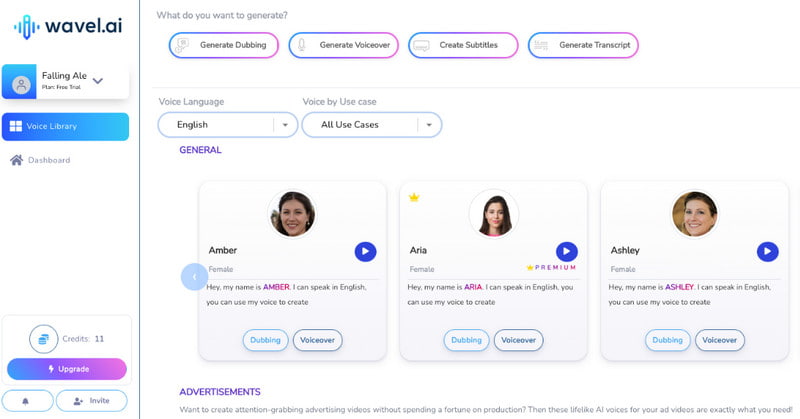
Best for: Ideal for business and YouTubers seeking full video localization.
Wavel AI is an exceptional tool if you want to localize your videos. It combines multilingual voiceovers, subtitles, and dubbing in one tool. You can even use this tool for creating training videos, educational videos, and cinematic content. It is also simple to operate, making it an ideal AI dubbing software for all users.
Pros
- The tool can handle dubbing smoothly.
- It can offer multiple voiceovers.
Cons
- Some users report reliability issues and occasional problems.
3. Maestra
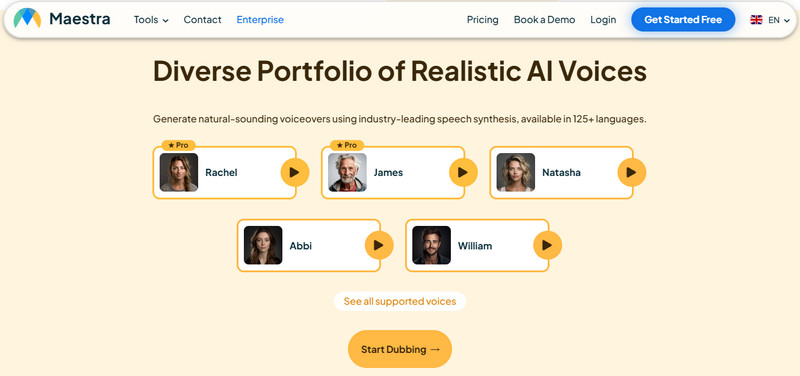
Best for: Perfect for educators, podcasters, and marketers.
If you want an AI dubbing tool that can support 100+ languages, look no further than Maestra. It can also support subtitles and collaboration features, making it more engaging to operate.
Pros
- It can offer a straightforward user interface.
- It can deal with dubbing, subtitles, and lip-sync.
Cons
- There are times when the accuracy level is unsatisfying.
4. DupDub
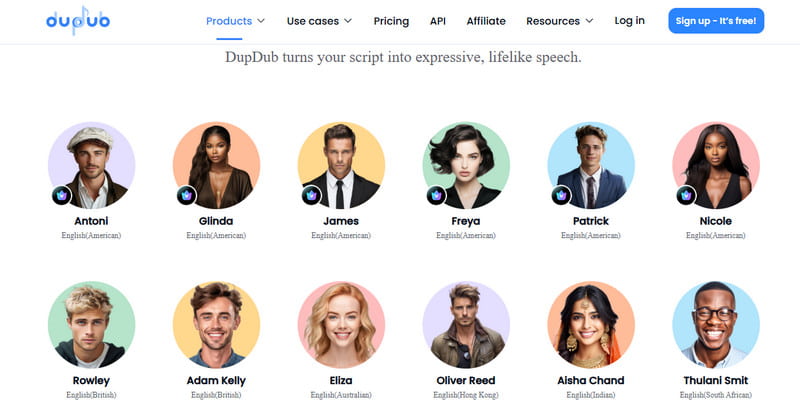
Best for: Ideal for influencers who want to dub videos instantly.
DupDub is an excellent AI dubbing tool that you use for various purposes. You can turn the text to speech, clone a voice, idea to text, and more. What makes it more powerful is that you can access various languages, making it an ideal tool for content creators.
Pros
- It is an all-in-one dubbing tool.
- The tool can offer various AI avatars.
Cons
- Sometimes, the tool does not give an accurate result.
5. Dubverse
Best for: Enterprises and creators who require scalable multilingual content.
Do you need an excellent dubbing tool that can offer a high-quality voice? Then, try using Dubverse. It can even provide fast dubbing, subtitle editing, and emotion modulation, making it strong for scalable multilingual projects.
Pros
- The dubbing process is fast.
- It can offer a void output with an accurate expression.
Cons
- Subtitles are not always accurate.
- The subscription is pricey.
Part 6. Comparison of the Best AI Dubbing Software
For more details about the best AI dubbing tools, you can view the table below.
| Voice Quality | Language Support | Real-Time | Lip-Sync | Best Use Case | Price |
| Dubbing AI | Natural, clear, tone-preserving | 30+ languages | Fast but not fully real-time | Accurate synchronization | Creators needing high-quality dubbing with minimal setup | Starts at $20.00 |
| Wavel AI | Good, varies by language | 40 languages | Near real-time for short content | Decent, sometimes imperfect | Businesses & YouTubers needing full localization | Starts at $30.00 |
| Maestra | Clear, sometimes robotic | 125+ languages | Batch processing only | Basic alignment | Educators, podcasters, marketers | Starts at $12.00 |
| DupDub | Expressive, customizable voices | 20+ languages | Quick dubbing for short clips | Good for social media, less precise for long videos | Social media creators & influencers | Starts at $25.00 |
| Dubverse | High-quality, emotion-rich cloning options | 100+ languages | Fast and scalable | Advanced sync with emotion modulation | Enterprises & professional creators | Starts at $11.00 |
Part 7. FAQs about Dubbing AI Voice Changer
Q: Is the dubbing AI voice changer safe?
A: It depends on the tool you are using. If you want a safe tool, feel free to use Dubbing AI, Maestra, DupDub, Wavel AI, and Dubvese. These tools ensure that you can achieve your desired result while securing all your information and content.
Q: Can AI dubbing sound natural?
A: Definitely, yes. Modern AI-powered dubbing tools are capable of providing a realistic output, allowing you to get an emotion-rich voice after the process.
Q: Does an AI dubbing tool support multiple languages?
A: Absolutely, yes. Almost all AI-driven dubbing tools can handle various languages for dubbing. Some tools support more than 30 languages, while others can handle 100+ languages.
Conclusion
Thanks to this detailed post, you have learned about Dubbing AI voice changers. You even get more insights on how it works, the applications of AI dubbing software, and various reliable AI dubbing tools. Thus, to get more information about the discussion, always visit this post anytime.
Ethan Carter
Ethan Carter creates in-depth content, timely news, and practical guides on AI audio, helping readers understand AI audio tools, making them accessible to non-experts. He specializes in reviewing top AI tools, explaining the ethics of AI music, and covering regulations. He uses data-driven insights and analysis, making his work trusted.


 by
by